
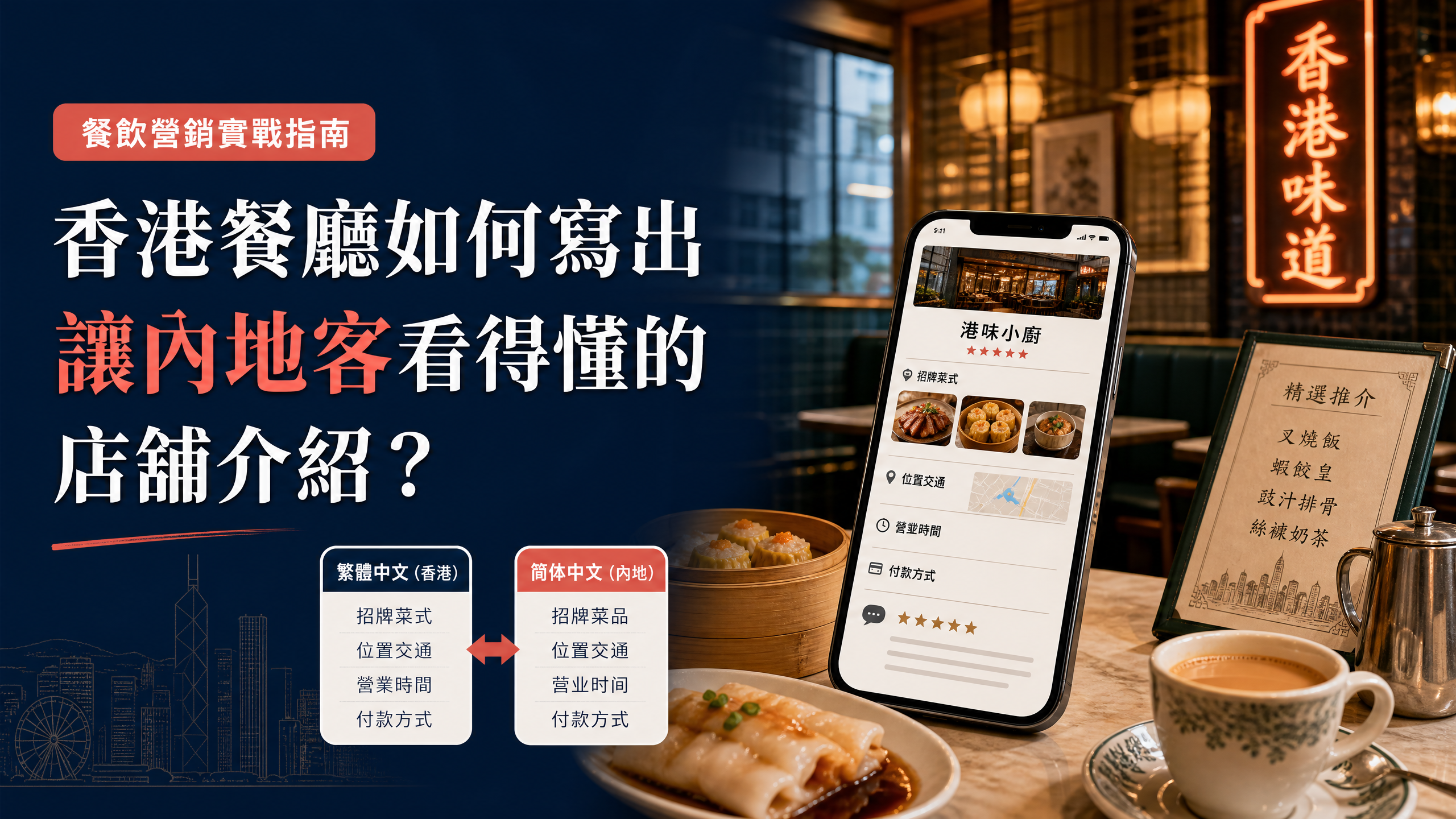
How Can Hong Kong Restaurants Write Store Introductions That Mainland Chinese Visitors Understand?
How Can Hong Kong Restaurants Write Store Introductions That Mainland Chinese Visitors Understand?
For Hong Kong restaurants, attracting Mainland Chinese visitors is not simply about converting Traditional Chinese into Simplified Chinese. A good restaurant introduction should help first-time visitors quickly understand what you serve, why it is worth visiting, how much it costs, how to get there, and how to make a reservation.
Many visitors discover restaurants through platforms such as Xiaohongshu, Dianping, Douyin, WeChat, Google Maps, travel websites and friends’ recommendations. Once they find your restaurant, they may compare several options within minutes. If your information is unclear, incomplete or too localised, they can easily choose another venue.
The most effective restaurant profile reduces uncertainty and makes the journey from online discovery to an in-person visit as simple as possible.
1. Do More Than Translate into Simplified Chinese
A direct translation is rarely enough. Hong Kong restaurants often use local terms that may be familiar to residents but unclear to first-time Mainland visitors.
For example, terms such as “add one,” “tea charge,” “book a table,” “dai pai dong,” or “hotpot” may need clearer explanation depending on the audience and platform.
| Hong Kong-style wording | Clearer wording for Mainland visitors |
|---|---|
| Book a table | Make a reservation / Reserve a table |
| Add one | 10% service charge applies |
| Tea charge | Per-person tea and condiment charge |
| Dai pai dong | Traditional Hong Kong-style open-air food stall |
| Cha chaan teng | Hong Kong-style café serving local comfort food |
| Two-dish rice | Hong Kong-style self-selected rice meal with two dishes |
| Take the MTR | Take the Hong Kong MTR |
| How many people? | Number of guests / Party size |
| Set menu | Meal set / Sharing menu |
| Walk-in welcome | Walk-ins are welcome, subject to availability |
The goal is not to remove Hong Kong character. Instead, explain local food culture in a way that visitors can understand and appreciate.
For example:
We specialise in classic Hong Kong-style hotpot, featuring daily fresh ingredients and house-made soup bases. It is an ideal choice for visitors looking to experience the city’s lively late-night dining culture.
This is clearer and more informative than simply saying “authentic Hong Kong hotpot.”
2. Start with What Guests Need to Know
The opening paragraph is the most important part of your restaurant introduction. Avoid starting with generic statements such as “We are committed to providing quality food and service” or “We create a warm and welcoming dining environment.”
Instead, quickly explain the restaurant’s location, cuisine, key dishes and reason to visit.
Weak example
Our restaurant is dedicated to providing customers with a high-quality dining experience in a comfortable and welcoming environment.
Stronger example
Located in Tsim Sha Tsui, our Hong Kong seafood restaurant specialises in classic Cantonese cuisine, fresh live seafood and local favourites such as typhoon-shelter-style crab, steamed fish and crispy roast goose. Just a five-minute walk from Tsim Sha Tsui MTR Station, it is ideal for family meals, shopping-day dinners and visitors exploring Victoria Harbour.
The stronger version answers several questions immediately:
- Where is the restaurant?
- What type of cuisine does it serve?
- What are its signature dishes?
- How convenient is it to reach?
- Who is it suitable for?
3. Write for Visitor Occasions, Not Only Brand Identity
Mainland visitors may not know your restaurant’s history or brand story. However, they know why they are in Hong Kong: shopping, sightseeing, a family trip, a couple’s getaway, a business visit, a concert, an exhibition or a weekend celebration.
Your restaurant description should connect with these dining occasions.
Useful visitor-focused phrases
- Ideal for a family meal after a day of shopping in Tsim Sha Tsui
- A convenient dining stop before or after visiting West Kowloon Cultural District
- Suitable for couples, friends and food lovers looking for a memorable Hong Kong dining experience
- Private rooms available for business dinners, family gatherings and celebrations
- Located close to major shopping destinations and tourist attractions
- A great choice for visitors looking to enjoy authentic Cantonese cuisine in a comfortable setting
- Group sharing menus available for friends travelling together
- Fast lunch service for business guests and visitors with a busy itinerary
- Photo-friendly interiors for couples, friends and social-media content creators
Instead of only describing your restaurant as “stylish,” “premium” or “comfortable,” explain what customers can actually do there and why it fits their trip.
4. Make Pricing and Charges Transparent
Visitors often hesitate when they do not understand the expected spend or additional charges. Clear pricing does not make a restaurant feel less premium. It helps attract diners whose budget and expectations match your offering.
Include the following wherever possible:
- Average spend per person for lunch and dinner
- Set-menu prices and what is included
- Price ranges for signature dishes
- Whether a 10% service charge applies
- Any per-person tea, condiment or cover charge
- Reservation deposit requirements
- Weekend, public-holiday or festive surcharges
- Minimum spend for private rooms
- Group-menu and sharing-menu options
Example
Average spend: Lunch from HK$128 per person; dinner approximately HK$350–500 per person.
Service charge: A 10% service charge applies.
Private rooms: Available with a minimum spend; advance reservation is recommended.
Group dining: Sharing menus are available for groups of 4 guests or above.
Transparent pricing reduces uncertainty before guests arrive and helps prevent misunderstandings at the point of payment.
5. Explain Location Like a First-Time Visitor
A Hong Kong address alone is often not enough for tourists. “Shop 302, 3/F, XX Mall, XX Road, Tsim Sha Tsui” may be accurate, but a visitor also needs to know which station exit to use, how long the walk takes and whether the restaurant is easy to find.
Include these details
- Full address, including building or mall name, floor and shop number
- Nearest MTR station and recommended exit
- Walking time from the station
- Nearby landmarks, attractions or shopping malls
- Taxi drop-off point where relevant
- Parking information for drivers
- Step-free access, lifts, stroller access or wheelchair accessibility
- A Google Maps, Apple Maps or local map-platform link
- Indoor walking instructions for rainy days, if the restaurant is in a mall or connected building
Example
Address: Shop 302, 3/F, XX Mall, XX Road, Tsim Sha Tsui, Kowloon, Hong Kong
MTR: Five-minute walk from Tsim Sha Tsui Station, Exit A1
Nearby landmarks: Harbour City, K11 Art Mall and the Tsim Sha Tsui Promenade
By taxi: Please search “[Restaurant Name] + [Mall Name]” for the most accurate drop-off point
Parking: Paid parking is available at the mall
Clear directions make the visit feel easier, especially for families, elderly guests, first-time visitors and diners travelling in rainy weather.
6. Make Reservations and Payment Easy
A customer who is ready to book should not need to search through multiple pages to find a phone number, WhatsApp contact or reservation link. Every restaurant profile should include clear booking instructions and a fast way to ask questions.
Include clear calls to action
- Reserve a table
- Check today’s availability
- WhatsApp us
- Call now
- View menu
- Enquire about private dining
- Book a birthday celebration
- Ask about group dining
For restaurants targeting Mainland visitors, it is also helpful to state payment options clearly.
Payment information example
Payment methods: Cash, Visa, Mastercard, UnionPay, WeChat Pay and Alipay are accepted.
Reservations: Advance booking is recommended for weekends, public holidays, private rooms and groups.
Enquiries: Contact us via phone, WhatsApp, WeChat or online reservation.
This practical information can make the difference between a visitor saving your restaurant for later and making a booking immediately.
Recommended Restaurant Profile Structure
Use the following structure for your website, Dianping listing, Xiaohongshu profile, WeChat account, Google Business Profile or reservation page.
Restaurant Introduction Template
[Restaurant Name] is located in [district / mall], Hong Kong, and specialises in [cuisine / dining concept]. Our menu highlights [key ingredients, cooking style or signature dishes], including [signature dish 1], [signature dish 2] and [signature dish 3].
With [interior atmosphere / view / private rooms / terrace / child-friendly facilities], the restaurant is suitable for [couples, families, business meals, friends, birthdays, group dining or visitors].
Average spend: Lunch from HK$[amount] per person; dinner approximately HK$[amount] per person. [Service charge, deposit, minimum spend or special policies].
Address: [Full Hong Kong address]. We are approximately [X] minutes’ walk from [MTR Station], Exit [X], and close to [nearby landmark].
Reservations: [Phone / WhatsApp / WeChat / online booking link].
Payment methods: [Cash / credit cards / UnionPay / WeChat Pay / Alipay].
For private rooms, celebrations, group bookings or special requests, please contact us in advance.
Full Example
Tsim Sha Tsui Hong Kong Seafood and Cantonese Restaurant
Harbour Master Kitchen is a Hong Kong seafood and Cantonese restaurant located in Tsim Sha Tsui. We specialise in traditional Cantonese cooking, fresh seasonal seafood and classic Hong Kong dishes, including typhoon-shelter-style crab, steamed fish, crispy roast goose and chicken cooked with fish maw in a clay pot.
The restaurant is a convenient choice for visitors exploring Victoria Harbour, shopping at Harbour City or spending the day in Tsim Sha Tsui. With comfortable seating, private dining rooms and group sharing menus, it is suitable for family meals, business dinners, birthday celebrations and friends travelling together in Hong Kong.
Average spend: Lunch from HK$138 per person; dinner approximately HK$380–550 per person. Group sharing menus are available for 2, 4 and larger parties. A 10% service charge applies. Private-room and public-holiday reservations are recommended in advance.
Address: Shop 302, 3/F, XX Mall, XX Road, Tsim Sha Tsui, Kowloon, Hong Kong.
MTR: Five-minute walk from Tsim Sha Tsui Station, Exit A1.
Nearby landmarks: Harbour City, Avenue of Stars and Victoria Harbour.
Reservations: Tel: +852 XXXX XXXX | WhatsApp: +852 XXXX XXXX | WeChat: XXXXXX.
Payment methods: Cash, Visa, Mastercard, UnionPay, WeChat Pay and Alipay are accepted.Looking for authentic Cantonese seafood during your Hong Kong trip? Reserve your table in advance and let us help make your dining experience memorable.
Final Checklist
Before publishing, make sure your introduction answers these questions within 30 seconds:
- What cuisine do you serve?
- Where is the restaurant located?
- What are the signature dishes?
- What is the typical spend per person?
- Is there a service charge, deposit or minimum spend?
- Who is the restaurant suitable for?
- Which MTR station and exit should guests use?
- How long does it take to walk from the station?
- How can guests make a reservation immediately?
- Which payment methods do you accept?
A restaurant profile does not need to be overly long or overly promotional. It needs to be clear, specific and useful enough for a first-time visitor to decide: This restaurant suits my trip, my group, my budget—and I know exactly how to book and get there.